The International HPC Summer School 2026
24 April 2026
EPCC has had a long association with the International HPC Summer School, and this year our colleagues will again be involved in organising and delivering the programme.
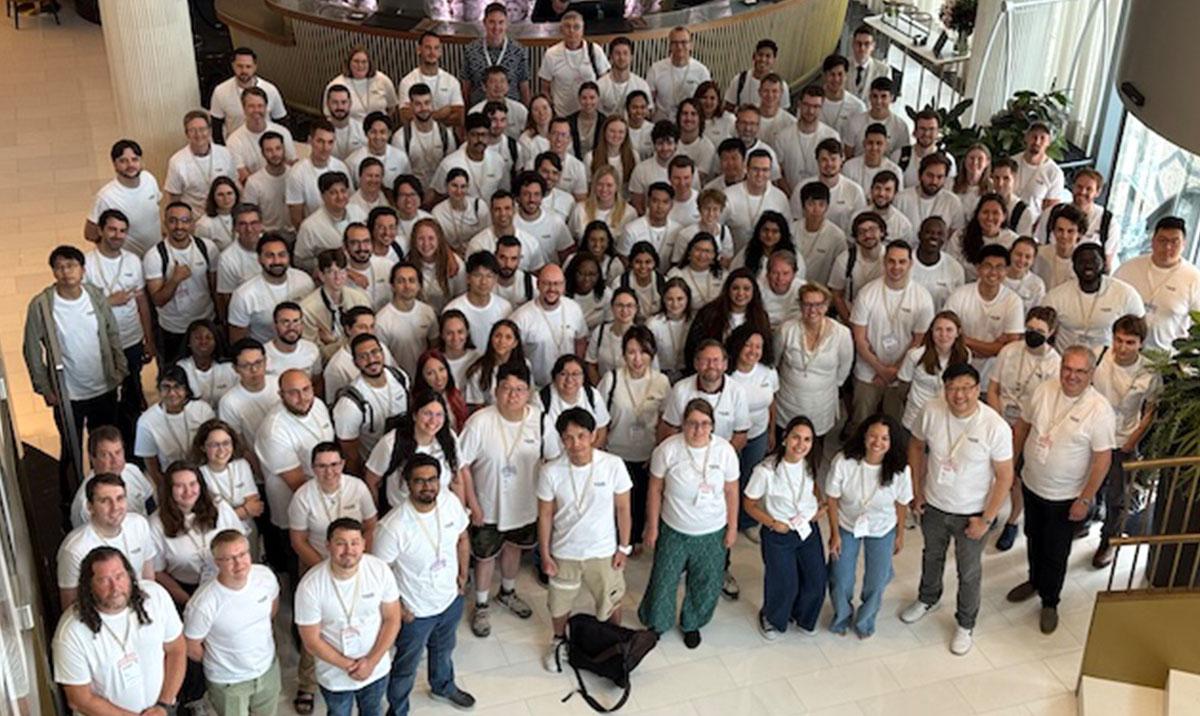
Above: participants of IHPCSS’25.
The International HPC Summer School (IHPCSS) is a week-long event for postgraduate students organised and run collaboratively by organisations from Australia, Canada, Europe, Japan, UK, USA and South Africa. The event has grown over the years and now brings about 90 students, 35 staff and up to 10 returning mentors (former student attendees) from around the world. Last year the event was held in Lisbon, Portugal, and the 16th edition of IHPCSS will take place in Perth, Australia in July.
EPCC has been privileged to be involved in the event since its first few editions in 2010-2012. Over the years, our instructors have taught both parallel programming tracks (OpenMP and MPI), shaped the mentoring programme and significantly contributed to the overall organisation of the event. I have been a member of the organising committee and led the Mentoring Programme since 2018. This year, EPCC's James Richings will teach the OpenMP programming parallel session and I will run the Mentoring Programme throughout the event.
UK participation in the last few events has been funded by EPCC, but we are happy to report the next few years will be funded by the EuroIHPCSS project (through the European High Performance Computing Joint Undertaking).
IHPCSS 2026 (12–17 July), will comprise hands-on technical sessions, conceptual lectures, discussion panels, structured and ad-hoc mentoring sessions, professional skills development sessions (including a poster session) and social events. The sessions are designed to engage participants with diverse skills and scientific backgrounds, and often run in parallel to offer a wider selection of topics, skills and tools.
Technical sessions
Technical sessions will cover parallel programming, performance analysis and optimisations, software engineering, scientific visualisations, workflow tools, containers, numerical libraries and machine learning at scale. The provisional agenda for IHPCSS’26 can be viewed on the event website.
The technical content is reviewed every year, and has evolved significantly since the School was first run in 2010. The details of how the technical content has evolved over the last 15 years can be found in a recent publication [1]. The demographics and motivations of the IHPCSS participants keep changing, so every year much effort is put into collecting feedback, understanding the skill landscape and adjusting the technical content. These comments, from two EPCC students who attended IHPCSS’25, illustrate the effectiveness of this approach:
"I had such a great time at the one-week HPC summer school! I really liked that we could choose a track that matched our background—it made learning HPC skills a lot less intimidating."
"During the school itself I was able to get some hands-on practice with the technologies I don’t often use day-to-day, such as OpenMP GPU offloading, and Apache Spark for big data. One of the very useful sessions was on managing large software projects, which I’ve been using since to manage my own project’s repository."
To help students consolidate their new skills, foster the development of collaboration skills and provide additional fun activities, the School also runs the Programming Challenge - in both competitive and non-competitive formats - where small teams work to improve the parallel performance of a naively parallelised code. The activity is optional but many students enjoy this opportunity to test their skill, as one our students noted:
"A highlight was the programming challenge, where I had the chance to directly apply the skills I had learned during the Summer School. I won third prize for optimising a given script using OpenMP!"
Mentoring Programme
Creating a sense of community for such a big and diverse cohort within the first few days of the event is difficult but also essential to create the open and safe environment required for non-technical mentoring [2].
Some structured sessions are dedicated to the development of non-technical professional skills such as presentation and communication, interviewing, and CV writing. Additionally, all staff members are required to stay for the whole duration of the School and participate in all formal mentoring sessions and social events, and be available for ad-hoc informal chats. The topics include career planning, work-life balance, dealing with difficult situations or people, preventing burnout, navigating imposter syndrome, leaving and finding new jobs, starting a family while developing a career, and many more.
A significant amount of time is also dedicated to exploring different career options - both within academia but also outside. Many of the returning mentors work in industry and are able to often provide insights into transitioning from the academic environment.
The mentoring programme has become one of the key and unique components of IHPCSS [3] and a highlight for both student and staff participants, as is shown by these comments from the EPCC students who attended last year:
"My favourite part was definitely the mentoring sessions. They were a great chance to meet other researchers with similar interests, and my mentor gave me super helpful advice about career options and what it’s like working in both academia and industry. On top of all that, I made lots of new friends and completely fell in love with Lisboa. Obrigado!"
"One of the best experiences was being paired with mentors to try and help us solve problems we were facing in our work, and my mentor was extremely helpful with us discussing career opportunities post-PhD, and consistent work habits for undertaking large research problems."
"Beyond the technical sessions, the Summer School created an excellent environment for networking and collaboration. Each participant was matched with a mentor based on their interests, leading to productive discussions before the School (in pre-departure ice-breaking sessions) and throughout the week (in career talks and goal-setting meetings). The resource fair offered the chance to connect with experts from academia, industry, and HPC centres, giving me valuable insights into the transition from academia to industry and the variety of technical and organisational roles available."
Applications for
Applications have now closed for the 2026 Summer School, but will open in late autumn 2026 for students and in early 2027 for the returning mentor participants of the 2027 School. We are excited to meet everyone who will be attending IHPCSS’26 in Perth in July!
References
[1] Scott Callaghan, Weronika Filinger, Ilya Zhukov, Hermann Lederer, and John Urbanic. 2025. Fifteen Years of International HPC Summer School. In Practice and Experience in Advanced Research Computing 2025: The Power of Collaboration (PEARC '25). Association for Computing Machinery, New York, NY, USA, Article 17, 1–8. https://doi.org/10.1145/3708035.3736011
[2] Scott Callaghan, Elsa Gonsiorowski, Weronika Filinger, and Ilya Zhukov. 2024. IHPCSS: Building Community for Short Training Schools. In Practice and Experience in Advanced Research Computing 2024: Human Powered Computing (PEARC '24). Association for Computing Machinery, New York, NY, USA, Article 79, 1–4. https://doi.org/10.1145/3626203.3670570
[3] Scott Callaghan, Elsa Gonsiorowski, Weronika Filinger, and Ilya Zhukov. 2024. Developing a Successful HPC Mentoring Program at the IHPCSS. In Practice and Experience in Advanced Research Computing 2024: Human Powered Computing (PEARC '24). Association for Computing Machinery, New York, NY, USA, Article 30, 1–9. https://doi.org/10.1145/3626203.3670519