
Piloting a Modern Apprenticeship at EPCC
11 May 2026
We are always looking for new ways to support early careers in our field, and most recently have piloted a Modern Apprenticeship in Digital Technology.
At EPCC we are committed to promoting and growing the skills required to develop and operate complex supercomputing and data science systems, and to help people find their way into careers in research computing systems administration, and research infrastructure engineering.
Modern Apprenticeships are a Skills Development Scotland scheme, and Digital Technology Apprenticeships can be undertaken at Higher/SCQF6 level or Higher National Diploma/SCQF8 level. We recently trialled the SCQF8 Digital Technology: Technical apprenticeship in Network Infrastructure.
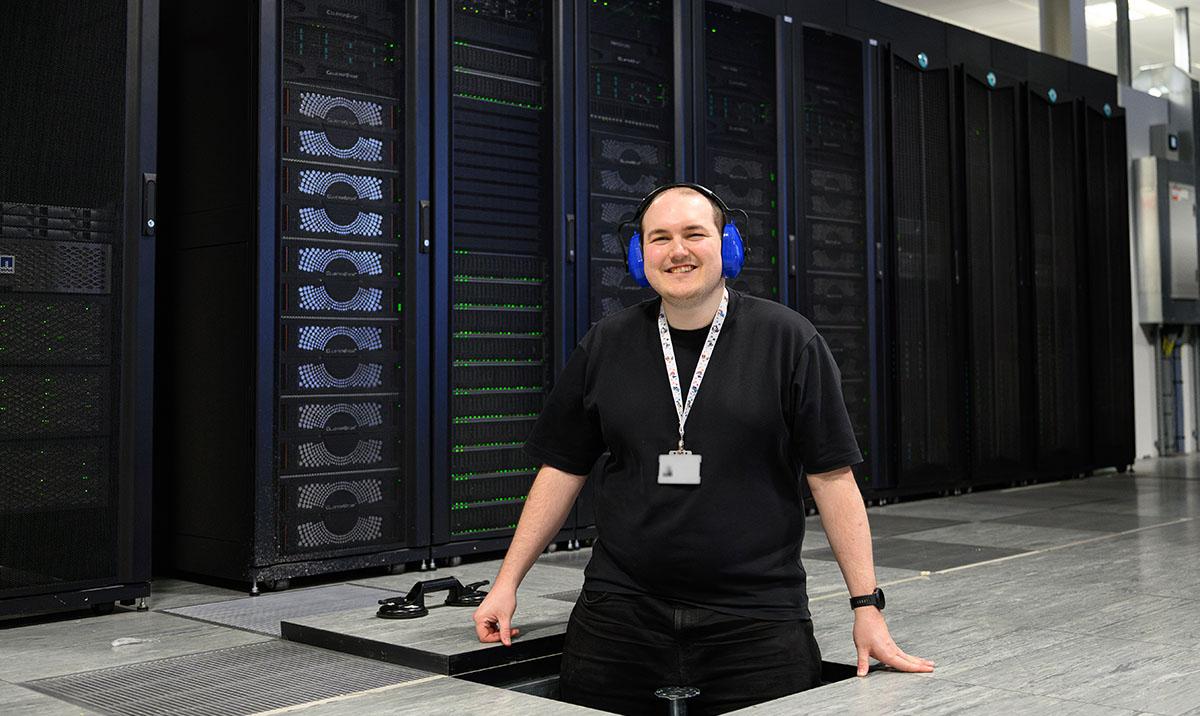
Our data centre technician Max Jones (pictured above) undertook the Apprenticeship, which combined a syllabus offered through an accredited provider (in our case QA) with on-the-job training and experience. Max joined EPCC in 2023 to support the large amount of racking, cabling and other infrastructure installation/decommissioning activity at our Advanced Computing Facility (ACF), and quickly proved an invaluable member of the team. The Modern Apprenticeship was an opportunity to build on the practical experience Max had gained with us and to start developing more general infrastructure engineering and system administration skills.
Max has recently successfully completed his Modern Apprenticeship, and this is an opportunity for us at EPCC to reflect and consider how this qualification might provide a way to get involved earlier in people’s journeys towards careers in research infrastructure engineering and an alternative route into our placements and Graduate Apprenticeships. Here Max writes about his experience of working with EPCC and completing the Modern Apprenticeship.
Working at the ACF
Probably the best thing about working about the ACF is the people who work here. Everyone is genuinely so nice and it creates a very positive working environment. As for the actual job I really enjoy the variety that the role can provide, for example I can spend part of the day configuring a network and then implement the physical solution for those changes.
Modern Apprenticeship structure
The Apprenticeship was split into online readings, live classes, and on the job experience. There were six modules, each relating to a different aspect of the role of network engineer. I was required to complete a reflection for each part within it, so a reflection for the online readings, a reflection for the live class and so on. Some modules were then further split into additional parts.
Taught element
The online course materials were excellent and a very good source of knowledge. The live classes were more of a mixed bag. The best were those with a teacher who was incredibly engaged and gave a lot of practical examples. Others involved working through labs individually and then discussing at the end of the day.
Hands-on experience
On the whole, my on-the-job experience was very positive. Each week I would discuss questions with my line manager who would then point me to the best member of the team to help. Everyone who works at the ACF has an incredibly solid understanding of their role, which made it easy for me to learn from them. It was also interesting to see how much of the theoretical knowledge I covered in the Apprenticeship was actually applied to the ACF.
Value of the Modern Apprenticeship
I believe the Modern Apprenticeship has been incredibly helpful for my personal development. I now know far more about networks than I did at the beginning of the course, though some of the modules were more relevant than others.
The main benefit of it is the pairing of a solid knowledge base, built through online learning, with actual practical experience of how that knowledge is implemented day-to-day. Another benefit is that there’s no exam - the qualification is built through evidence collected over the course of the Apprenticeship.
Challenges
Because the course is largely self-taught, you need to be on top of managing your own deadlines and time. Another challenge is that sometimes you’ll be asked to do on-the-job experience for something that we don’t really do at the ACF, which means trying to work with a hypothetical situation.
Conclusion
The parts of the course that were relevant to data centre infrastructure were excellent and I absolutely learned a lot that has helped me within my role. However, there are also a few modules/questions that more pertain to Enterprise IT and were not very applicable to what I do day-to-day. But I would say that it is very useful for someone starting with the same knowledge base that I had at the beginning of the Apprenticeship.
Find out more
Modern Apprenticeship in Network Infrastructure