Understanding weather and climate dynamics using high-resolution global cloud resolving models
25 February 2026
EPCC's Evgenij Belikov writes about the challenges of refining the resolutions of global cloud resolving models, a key component for advancing understanding of atmospheric physics and dynamics at the “grey zone” sub-kilometre scales both for regional and global climate and weather simulations.
Insights gained from Global cloud resolving models (GCRMs) [1] help address challenges in application areas of critical importance such as response to environmental hazards, in particular storms, and for renewable energy systems planning, for example wind resource assessment and wind farm placement. Reaching the finer resolutions requires harnessing the unprecedented compute power of modern supercomputers and accelerators.
To address this challenge, a project funded by the NERC Seedcorn Fund brings together complementary expertise from three partner institutions to establish strategic international collaboration at the intersection of wind energy systems, atmospheric science and Exascale computing.
We use the MPAS-Atmosphere (MPAS-A) component of the Model for Prediction Across Scales (MPAS), which is based on an unstructured centroidal Voronoi tessellation (mesh) with C-grid staggering, which can be either quasi-uniform or with a smooth transition to a refined region of interest to avoid discontinuities associated with abrupt transitions. MPAS-A’s dynamical core incorporates an atmospheric fluid solver for fully compressible non-hydrostatic equations of motion [2] combined with physics schemes from the Advanced Research Weather Forecasting Model and has demonstrated high scalability [3].
ARCHER2 Celebration of Science poster presentation
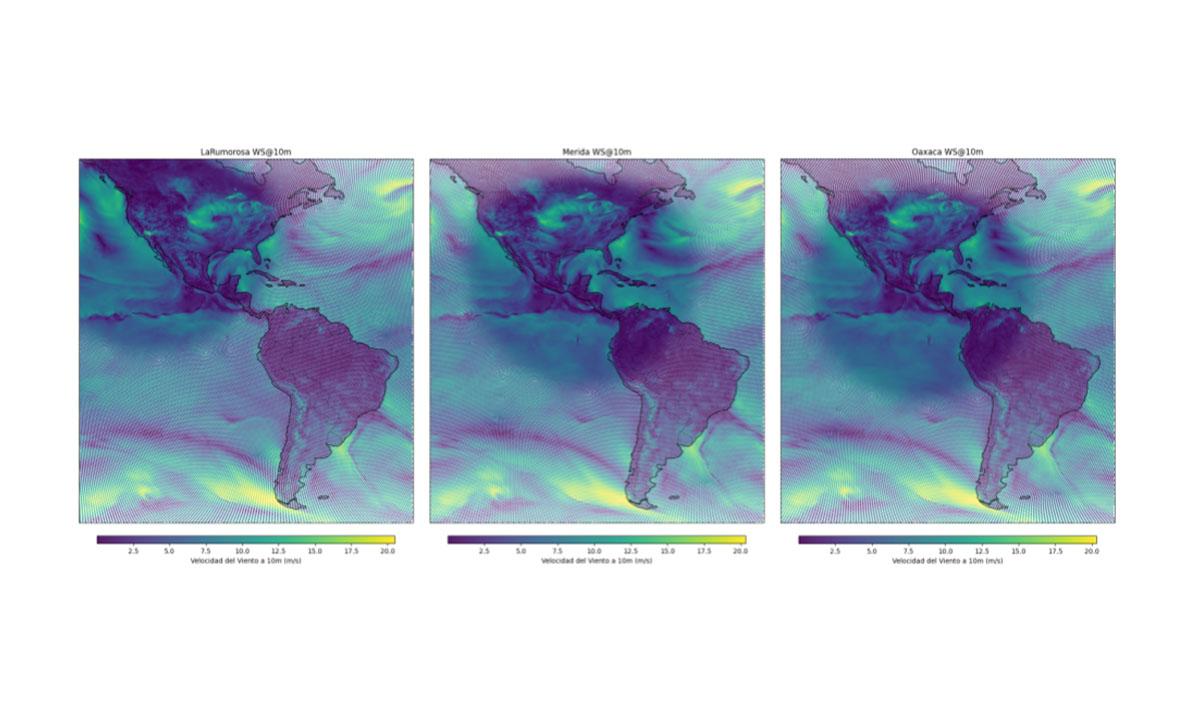
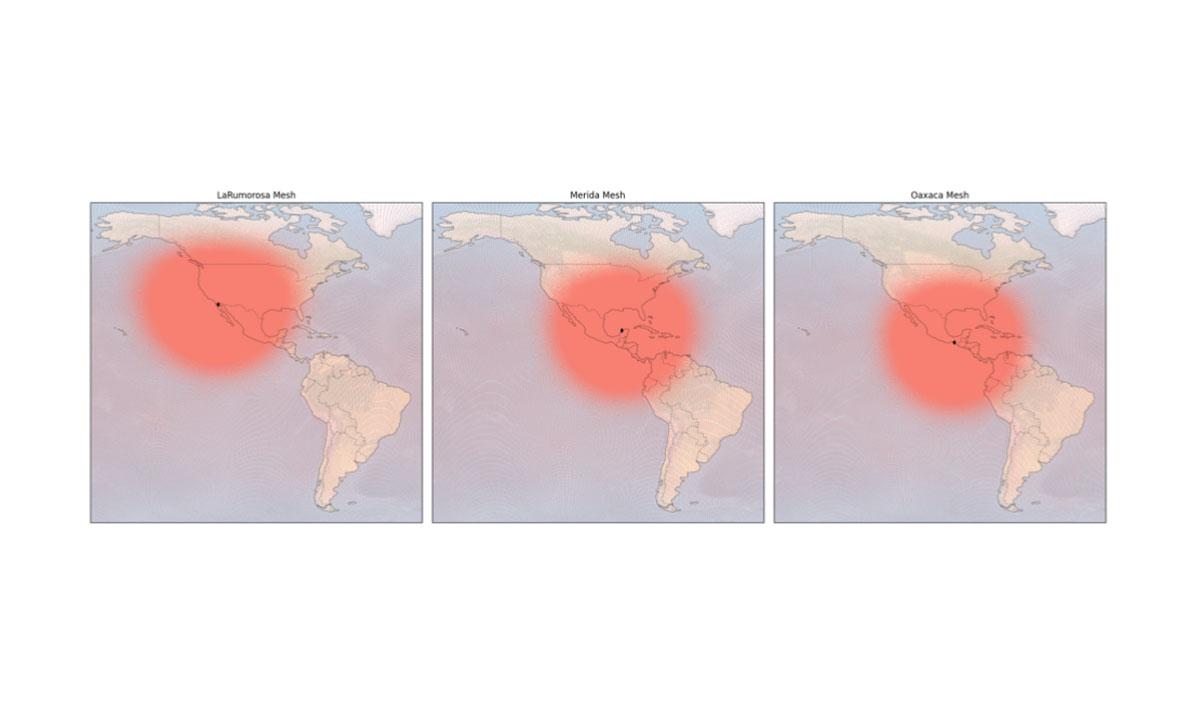
At the upcoming ARCHER2 Celebration of Science event, we will present the results from the physics scheme sensitivity studies at three diverse Mexican locations: La Rumorosa, Merida, and Oaxaca, using a publicly available non-uniform mesh with 60km to 3km resolution. The refined region is re-centered to location of interest (see image below). The vertical grid employs 20m spacing within the first 200m above ground level, facilitating detailed comparisons of wind speed (as shown in the figure above; both images courtesy D. Canul and V. Magar, CICESE), temperature, and relative humidity between model output and meteorological station data collected at heights ranging from 20m to 80m above ground.
This work lays the foundation for international collaboration moving to finer mesh resolutions and investigating the performance of GPU-enabled MPAS-A to leverage next-generation computing infrastructure. Future work will also include investigating Large Eddy Simulation and 3D Planetary Boundary Layer implementations in MPAS-A for improved analysis of wind patterns over complex terrain and at sea. The insights gained from high-resolution GCRMs will help increase resilience in face of extreme weather events and support meeting net zero emission targets by aiding the transition to renewable energy systems.
Project partners
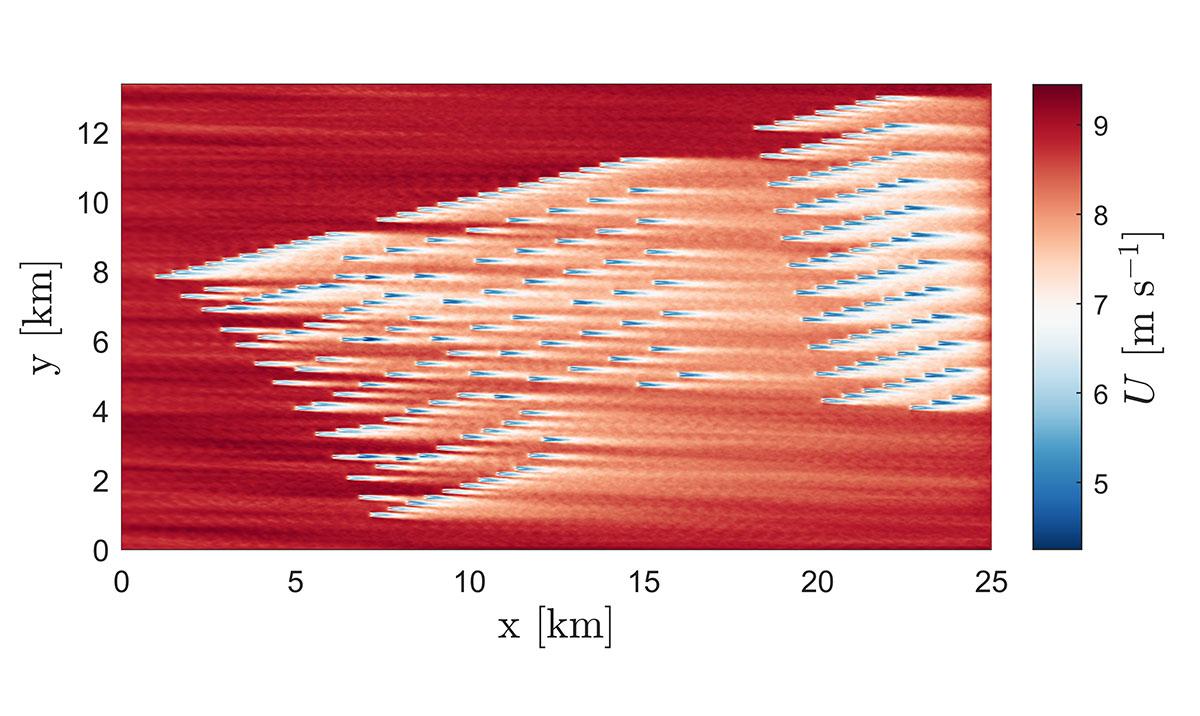
The Department of Wind and Energy Systems at the Technical University of Denmark (DTU) is a leader in atmospheric flow observations and in the use of meteorological models to assess the impact of the atmosphere on wind energy systems, e.g. assessing the effects of wakes from wind farms on downstream wind farms (see figure below; image courtesy Alfredo Peña, DTU).
The Physical Oceanography Department at the Center for Scientific Research and Higher Education (CICESE) at Ensenada, Mexico, operates meteorological forecasts and weather and climatological databases for the Mexican Northwest.
EPCC at the University of Edinburgh is UK’s first National Supercomputing Centre, hosting and operating the national supercomputer ARCHER2 and the Edinburgh International Data Facility.
References
- Satoh, M., Stevens, B., Judt, F., Khairoutdinov, M., Lin, S. J., Putman, W. M., & Düben, P. (2019). Global cloud-resolving models. Current Climate Change Reports, 5(3), 172-184.
- Skamarock, W. C., Klemp, J. B., Duda, M. G., Fowler, L. D., Park, S. H., & Ringler, T. D. (2012). A multiscale nonhydrostatic atmospheric model using centroidal Voronoi tesselations and C-grid staggering. Monthly Weather Review, 140(9), 3090-3105.
- Heinzeller, D., Duda, M. G., & Kunstmann, H. (2016). Towards convection-resolving, global atmospheric simulations with the Model for Prediction Across Scales (MPAS) v3. 1: An extreme scaling experiment. Geoscientific Model Development, 9(1), 77-110.