EPCC at The Royal Society Summer Exhibition
5 August 2026
Kyro Hartzenberg writes about EPCC's successful first appearance at this prestigious public celebration of science in London.
I recently had the opportunity to join fellow colleagues in London to volunteer at EPCC's exhibit at the Royal Society Summer Science Exhibition. This blog post will explain what outreach activities were carried out at the exhibit and my own personal experience in taking part as a volunteer.
Raising public awareness
EPCC's presence was led by Darren White, Laura Moran and Dr Lorna Smith. Titled 'Supercomputing: the good, the bad and the beautiful', it highlights how supercomputers help address urgent challenges to our health, our security and our planet.
The opportunity to have an exhibit at the The Royal Society Sumer Exhibition was timely as the next National Supercomputer is in the pipeline, a system that will provide vastly more supercomputing power than before.
However, volunteers went beyond just raising awareness and demystifying the next National Supercomputer. We introduced members of the public, science professionals and students to the varied services and outputs of EPCC including the leading work in high performance computing, AI and data science expertise.
Outreach activities
The EPCC exhibit had three different outreach activities, allowing us to engage with a broad audience.
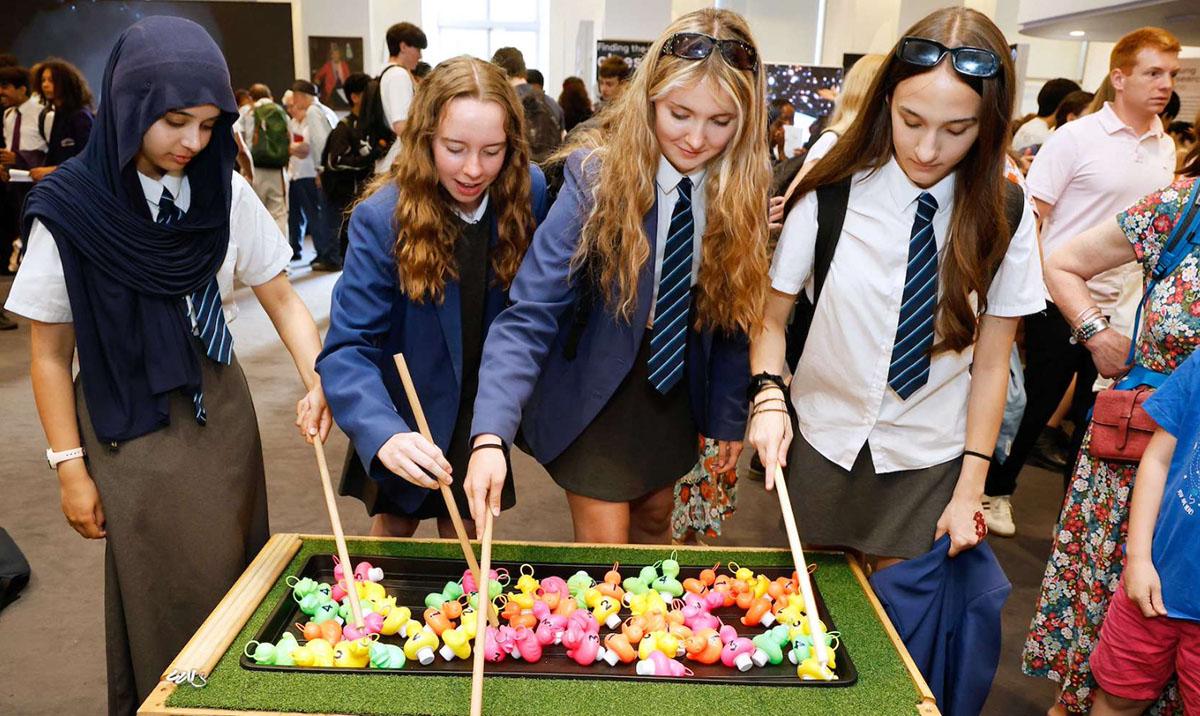
Above: Hook-a-duck challenge. Photo: Debbie Rowe.
Hook-a-duck
This was a simple sorting activity, which was a hit with visitors of all ages, backgrounds and levels of prior knowledge. Visitors had 30 seconds to sort as many ducks into the corresponding lanes as possible. The key takeaway is that the more people you have to do the sorting, the bigger the number of items sorted, demonstrating how modern supercomputers work. Supercomputers are essentially lots and lots of computers all connected together so they can work in parallel on the same problems. The laughter and excitement this activity created certainly drew in large crowds from across the room, allowing us volunteers to reach a wider audience throughout the exhibition.
VR tours (360 videos)
There were three tours available to visitors:
- Wind Turbines: Measuring how the turbulence behind wind turbines interact can't be measured directly without causing an effect - simulations help us do this without affecting the turbulence and altering the results. This can help improve the efficiency of wind turbines, increasing the amount of energy we can get from "green" sources, key for the push towards net zero and reducing our environmental impact.
- The Universe: How it evolves over billions of years. Observations from telescope can give us "snapshots" but simulations allow us to track how galaxies, dark matter, etc all interact.
Two stands in the same room are all about astronomy - Universe Makers provided the video shown here, and EUCLID are trying to observe "the dark universe" - ARCHER2: The video shows the ARCHER2 machine itself in Computer Room 3 (CR3) as well as Plant room C (PRC) which provides the electricity, cooling, etc. It shows how big these machines are, and that they require a lot of extra support equipment to keep them running.
The immersive nature of VR also created a memorable experience that helps visitors retain information and generates excitement about high-performance computing.
Data centre simulation game
The final activity was presented to visitors on an iPad, inviting them play the simulation as the new owner of an island, which just so happens to have a data centre with 1MW of power for compute. The simulation demonstrates that climate change is having a major impact and the island is slowly degenerating, turning from a lush green, forested island to a barren desert. The major source of income for the island is the science jobs run on the supercomputers. With this virtual cash, visitors can choose several options:
- Regeneration - pay to make a chunk of your island green again. This is a good quick fix, but the island is still slowly degrading
- Wind turbines and solar panels - decreases the fossil fuel usage, which slows the degeneration
- Cooling fans - decreases water usage, and improves efficiency (lowers fossil fuel use further) which slows degeneration
The visitor wins the simulation game once the island becomes 100% self-sufficient. Alternatively, they lose once the island becomes 100% barren. This activity provided a more technical and interactive experience for visitors who wanted to explore concepts in greater depth.
Diversity and inclusion
A major strength of the exhibit was that it was designed to be accessible and inclusive to a wide range of visitors, regardless of age or background. The makeup of the volunteering team reflected this same strength - the exhibit reflected a welcoming balance of volunteers, as they were from various educational backgrounds, ages and level of technical knowledge and expertise.
During the EPCC briefing session, volunteers were told: "We are all different, some of us are bubbly, some outgoing, some quieter. Whatever your personality, it is great for the booth, don't worry about being like other people. Attendees are just curious and will get the most from the booth if you are authentic. So just be you." I am confident that this message was carried through and visitors were able to see that supercomputing is not only for a particular group of people and that it is a field that benefits from collaboration between people with a wide range of skills, backgrounds and experiences.
As a woman without a science or computing background, I initially assumed that I might not have the technical expertise needed to make a meaningful contribution to the exhibit. These fears were mitigated at the EPCC briefing session when we were reminded that: "You won’t know the answer to everything, it's just not possible."
At the exhibition, I soon realised that successful outreach relies on more than technical knowledge. Communicating with visitors, making people feel welcome, encouraging participation and helping explain concepts in a simple and approachable way are all equally valuable skills.
Final thoughts
Overall, I thoroughly enjoyed this experience - from learning more about supercomputing and contributing to the outreach activities to meeting hundreds of people from all backgrounds who are interested in science. I am also particularly grateful that I got to work alongside colleagues from different teams and to hear about their experiences and the work they're doing.
This article was first published on the website of the Software Sustainability Institute.
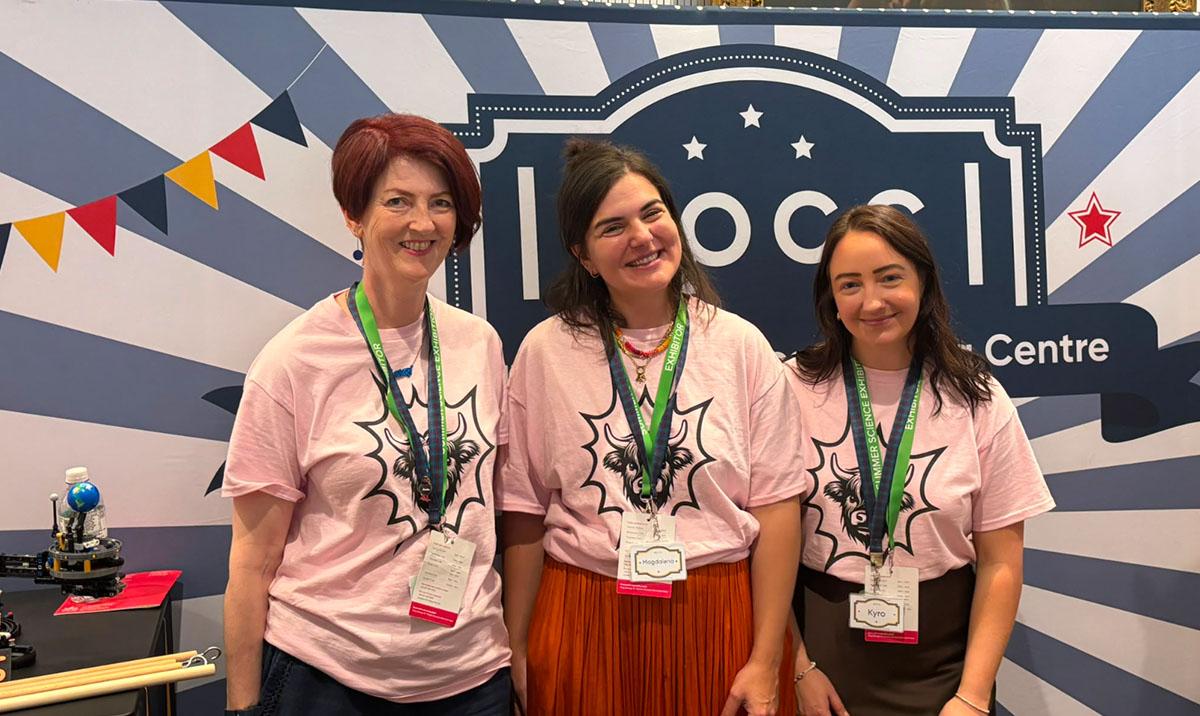
Below: Some of the EPCC team at the Royal Society Summer Show.