
Want to port scientific codes to a chip the size of a dinner plate?
4 May 2026
We've got a fully-funded PhD for that!
The AI boom has triggered the most exciting era of computer architecture in decades. For example, wafer-scale processors with hundreds of thousands of cores etched onto a single piece of silicon, RISC-V accelerators packing thousands of tiny Tensix cores onto a single die, and spatial dataflow engines that throw the entire Von Neumann model out of the window.
This hardware was built to train neural networks, but it's also some of the most powerful, energy-efficient floating-point machinery ever made. But what else can it do? That's exactly what this fully-funded PhD at EPCC, in collaboration with AWE, is here to find out.
As the UK's first National Supercomputing Centre, EPCC hosts one of the most diverse collections of novel accelerators in the UK. These include the Cerebras Wafer-Scale Engine (a chip the size of a dinner plate with around a million cores and unprecedented on-chip memory bandwidth), Tenstorrent Wormhole and Blackhole accelerators, AMD's AI engines, and a range of FPGAs. Your job will be to discover how to bend this hardware to the will of traditional scientific computing including stencil codes, FFTs, CFD solvers, combustion simulations, and the kind of memory-bound algorithms that have always struggled to fully exploit GPUs. Existing work from EPCC has already shown the potential for these architectures to address the bottlenecks that hobble conventional architectures, and there's a lot more territory left to explore.
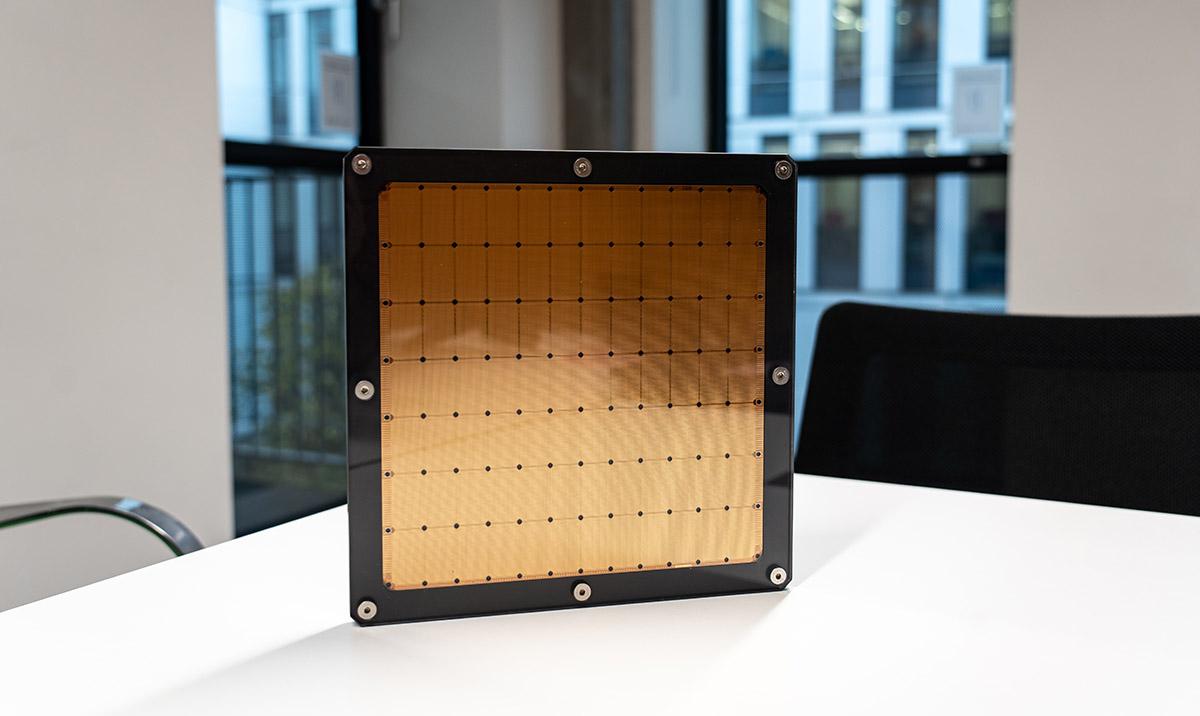
Above: the Cerebras Wafer-Scale Engine.
Supervised by me, you'll get hands-on access to genuinely exotic hardware. This isn't a project where you'll be tweaking known frameworks at the margins, instead you will be redesigning algorithms from the numerics upwards, experimenting with reduced-precision representations like bf16, asking fundamental questions about which classes of HPC workloads suit which classes of emerging hardware, and redesigning algorithms to suite the unique execution models of these different architectures.
It's a rare chance to work at the point where numerical algorithms, computer architecture, and computational science all collide, and to publish at top venues where the rest of the field will be paying attention. This project will be run in collaboration with AWE, who will provide real world mini-applications and algorithms of genuine scientific interest, which means the work will have direct impact beyond an academic benchmark suite.
Apply now
This PhD is funded jointly by AWE and EPSRC, with a stipend of around £2,500 per year above the standard UKRI rate plus a generous travel budget.
Applicants must be UK national with a strong Masters degree (or 1st-class integrated Masters) in computer science, physics, maths, or a related discipline, and confident programming in C, C++, or Fortran.
If you meet these requirements and are interested, then reach out to me to discuss further: Nick Brown, EPCC.
Application deadline: 28 May 2026.
PhD study at EPCC
For details of all our available PhDs and examples of our students' research, see our PhD pages.