Edinburgh supercomputing history: Meiko T800 Computing Surface
21 May 2026
At 3pm on Monday 12 May 1986, the first entry was made in the logbook for the University of Edinburgh's Meiko T800 Computing Surface system, hosted in the University's James Clark Maxwell Building.
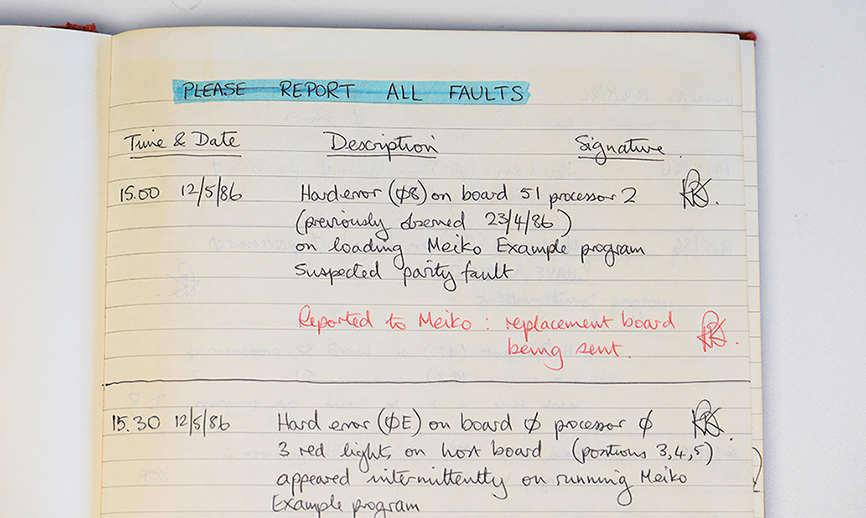
Above: the first entry in the logbook of the Meiko T800 Computing Surface system.
Four years later, the Meiko T800 Computing Surface system would be part of the Edinburgh Concurrent Supercomputer project - the immediate predecessor of EPCC. Many of the people involved in the running of that system were instrumental in the foundation of EPCC, including the author of that first log entry, Professor Richard Kenway.
Supercomputer performance is measured in number of floating-point operations per second (flop/s). The Edinburgh Concurrent Supercomputer was capable of 500 million per second - 0.5 gigaflops. ARCHER2, the current UK National Supercomputing Service, which is hosted and operated by EPCC, has a peak performance of 28 petaflops - 28 million billion operations. Each of the 5,860 nodes in ARCHER2 has 256 gigabytes of memory. In total, the Meiko system had around 1.6.
Forty years later, one rack from that system now sits alongside the logbook at EPCC's Advanced Computing Facility as a reminder of our beginnings.
One group using the Meiko system was the UKCP consortium, also a current user of ARCHER2. Similarly, modern descendants of the quantum chromodynamics (QCD) simulations that were run on the Meiko now use the Tursa system. EPCC operates this service on behalf of DiRAC, which provides high performance computing (HPC) services to the UK’s Scientific Research Communities in theoretical cosmology, nuclear physics, astrophysics, particle physics, and solar and planetary science.
EPCC is currently preparing to host the next UK National Supercomputing Service, so continuing our tradition of supporting and enabling scientific research.
Links
Read more about the evolution of EPCC: A brief history of EPCC.
Visit our virtual museum: EPCC History of Machines.