EPCC bespoke training supports the development of unparalleled engineering simulations
28 July 2026
EPCC recently hosted colleagues from Queen's University Belfast and the University of Cambridge for a course on parallel programming. As explained here, this training will directly support advances in engineering simulations.
The five-year VECTA (Virtual Exascale Calculations Transform Aviation) project is working towards the simulation of a whole jet engine, something that has not been previously attempted. It is a collaboration between Rolls-Royce, EPCC, Queen's University Belfast (QUB), the University of Cambridge, the University of Surrey, the University of Warwick, Turbostream, and ITI Solutions, Inc.
REMODEL is a programme grant to advance Parallel Mesh Generation and Geometry Representation to Enable Industrially Relevant, High-Fidelity Simulations that brings together researchers from five UK universities: Swansea University, Imperial College London, King's College London, Queen's University Belfast, and The University of Edinburgh.
In a regular all-partner VECTA project meeting earlier this year, some of our colleagues remarked that they had difficulty following technical discussions that include details of parallel programming because they don't have a background in high performance computing (HPC). To allow everyone to engage with all the material, EPCC therefore organised a bespoke course on parallel programming based on some of the material that we deliver to our MSc students.
Each VECTA project partner brings their own expertise. For example the creation and maintenance of meshes, which are large datasets that describe the 3D shape of objects, in this case jet engine parts (QUB); or finite element analysis, which simulates the deformation and heat transfer of the parts defined by these meshes (University of Cambridge). EPCC's expertise includes the deployment and management of HPC systems and the development of parallel software, but also teaching parallel programming. After all, we have been teaching high performance computing for 25 years! We then extended an invitation to colleagues from REMODEL, a project whose objectives complement VECTA's.
We hope our VECTA and REMODEL colleagues found the week they spent with us to be useful, and we look forward to hosting them again. Below they describe their work and their experiences at EPCC.
Jude Hussain
Queen's University Belfast
Engineering simulation is facing a scale crisis. Significant progress has been made in solver-based parallelism, but robust geometry handling and meshing pipelines are scarce. In fact, no standard exists for “distributed CAD” – a problem that I set out to address. The REMODEL programme sets out to develop the next generation of parallel geometry and meshing tools for exascale-level simulations. It brings together EPCC's expertise in HPC and hardware, QUB and Swansea University's expertise in geometry and meshing, and solver pipelines and optimisation from King’s College London and Imperial College London. As a postdoctoral research fellow at QUB, my role is to build a pipeline that facilitates “distributed CAD” – that is, load-balanced distribution and parallel deserialisation of industrial-grade CAD geometries.
My experience working in engineering consultancy shapes how I approach the scaling challenge. Industrial CAD models are complex, massive, and were never designed for exascale environments. My work demands intimate knowledge of parallel programming paradigms to develop robust and efficient partitioning, distribution, and deserialisation pipelines that preserve the integrity of the original CAD. Management of data migration, exchange, and fidelity is essential to my work package. This necessitated a visit to EPCC, who lead the parallel computing work package on REMODEL, and a week-long residency at the Bayes Centre!
The week was divided into two two-day dives into the semantics of shared and distributed-memory parallelism. Shared-memory parallelism via OpenMP encompassed nested parallelism, the OpenMP memory model, and performance tuning. The MPI session - most relevant to my work - covered aspects of communication, non-blocking operations, and derived data types for complex memory layouts.
Discussions around data locality and order of operations were extremely useful, with implications for inter-node CAD access. The training offered a principled mental model for portable and scalable software design.
The collaborative environment at EPCC is unparalleled (pun intended) and the instructors went beyond the formal material to engage with software design questions specific to my REMODEL work.
The course will feed into the next phase of the geometric REMODEL package, as the distributed CAD pipeline moves from partitioning theory into live data distribution across processor ranks. The week gave me the tools to build that layer properly and the procedural thinking to test performance and scaling in the code I develop. A key takeaway: don’t think — test!
I left a happy, load-balanced engineer!
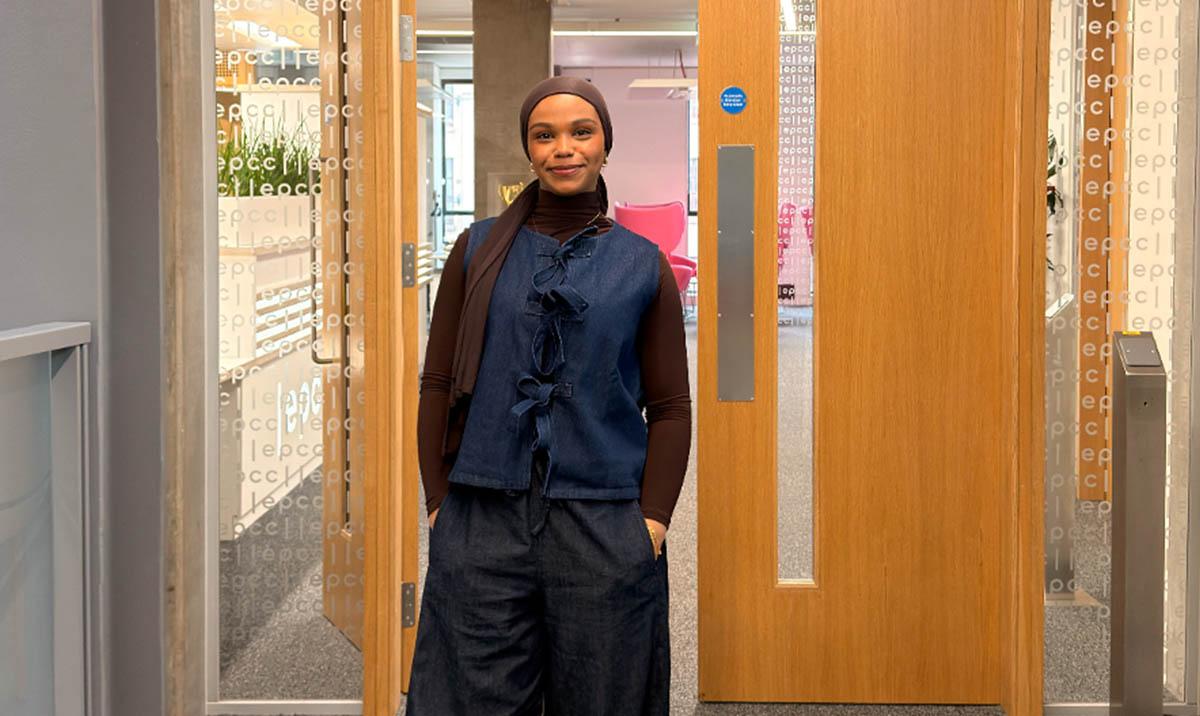
Jude Hussain (shown above) is a Research Fellow in the School of Mechanical and Aerospace Engineering, Queen's University Belfast.
William Haskins
University of Cambridge
VECTA's aim, to harness exascale computing to run high-fidelity simulations of the operation of an entire turbine engine, will allow for faster development time frames of new generation jet engines that can utilise greener technologies such as sustainable aviation fuel and hydrogen turbines. This can only be accomplished through well optimised parallel code that scales up to run efficiently on large supercomputer clusters. My role in this is the creation of contact algorithms that can be efficient whilst being applied to the 10,000s of components present in a jet turbine engine.
I attended the EPCC course primarily to expand my knowledge of parallel computing and to improve my coding practices. The session on running and designing parallel MPI codes on the UK National Supercomputing Service ARCHER2 gave me practical experience. This improved my ability to develop and optimise code on HPC clusters of a similar size to those on which I will run simulations in the future. Additionally, being taught by academics with many years' parallel computing experience and running parallel codes on real supercomputing systems helped me understand how to better write scalable codes.
I found it particularly useful to learn about GPUs, including how they vary in structure from CPUs and how to use them. The hands-on experience with programming GPUs using OpenMP was extremely useful and I hope to implement this knowledge to run finite element simulations in future years of my PhD.
William Haskins is a first year PhD student in the Department of Engineering, University of Cambridge
Kenanao Sithole
Queen's University Belfast
VECTA aims to exploit emerging exascale computing technologies to enable high-fidelity simulation workflows for complex aero-engine systems. My research focuses on simulation model management, cellular modelling, and the development of methods to automate the transfer and application of analysis information between different engineering representations.
Although my current work does not involve developing parallel applications directly, high-performance computing is becoming increasingly important as the scale and complexity of engineering simulations continue to grow. Future developments within VECTA are likely to require handling large datasets, interrogating complex geometric models, and potentially accelerating algorithms associated with cellular modelling, topology extraction, and simulation data management. Developing an understanding of parallel programming concepts at this stage therefore provides a strong foundation for future research activities and allows me to engage more effectively with colleagues working on computationally intensive applications.
Attending the EPCC Parallel Computing training course was an excellent opportunity to build this knowledge. The course provided a practical introduction to key concepts in shared-memory parallelism, including OpenMP programming techniques, performance considerations, and approaches for identifying opportunities to exploit concurrency in existing codes. While I may not immediately apply these techniques in my current research, the training has given me a much better appreciation of how software can be designed to take advantage of modern multicore architectures and large-scale computing facilities.
One aspect of the course that I particularly appreciated was the style of delivery. The sessions were highly interactive and balanced theoretical explanations with hands-on exercises, allowing participants to experiment with the concepts as they were introduced. Having dedicated time to work through examples, coupled with the opportunity to ask questions and receive support directly from the instructors, made the material much more accessible. Learning in person also encouraged discussion among participants from different disciplines, which provided useful insights into the diverse ways parallel computing is being applied across research domains.
Kenanao Sithole is a Research Fellow in the School of Mechanical and Aerospace Engineering, Queen's University Belfast.