
From EPCC MSc to PhD and SC26: investigating RISC-V for high performance computing
18 November 2026
RISC-V is an increasingly important architecture, offering an open instruction set architecture that is attracting interest from processor designers, researchers and the high-performance computing (HPC) community. EPCC PhD student Richard Neale writes about his research in this area.
Identifying the potential of RISC-V based processors and accelerators to deliver the performance required by HPC applications, and how future standards and development can be shaped, is a big part of the work carried out at EPCC by Dr Nick Brown and his research students group. Richard Neale began his PhD studies, supervised by Nick, at the beginning of 2026. As he explains here, these questions form the focus of his PhD research at EPCC, leading to the presentation of a research paper in the RISC-V for HPC workshop at SC26.
My journey with EPCC began during the COVID-19 lockdowns, studying online for an MSc in High Performance Computing. I successfully completed this programme in 2025. My dissertation investigated the optimisation of Basic Linear Algebra Subprograms (BLAS) using RISC-V Vector (RVV) instructions. This provided an opportunity to explore how the emerging RISC-V vector extension could be used to accelerate computational workloads, and introduced me to the possibilities offered by this architecture.
On completing my dissertation, I had the feeling that this was just the beginning of what could be investigated. The work had shown the great potential of this emerging technology, particularly around the potential of RISC-V beyond conventional CPU implementations. An opportunity arose to continue this area of research at doctoral level, under the supervision of Dr Nick Brown. I began my PhD at the start of 2026, continuing investigations into the application of RISC-V technologies to HPC.
RISC-V testbed at EPCC
The big advantage of undertaking this research at EPCC is access to the EPCC RISC-V testbed, one of the RISC-V International ecosystem labs. This provides opportunities to work directly with emerging RISC-V hardware rather than relying exclusively on simulation or theoretical models.
Access to such hardware has been particularly valuable for my research, allowing me to investigate architectures that are still relatively new to the HPC landscape. The combination of access to specialist hardware and supervision from Nick Brown, who chairs the RISC-V Special Interest Group on High-Performance Computing (SIG-HPC), creates a rich environment in which it is possible to explore both the architectural and practical implications of these technologies.
Accelerator architectures
My initial PhD investigations have focused on the Ainekko ET-SoC-1, a RISC-V-based accelerator card incorporating both vector processing capabilities and specialised Tensor execution hardware. Initially developed by Esperanto, the ET-SoC-1 provides an opportunity to investigate differing approaches to accelerating computational workloads within the same device. In particular, I have been examining the performance of its proprietory vector instructions alongside its Tensor FMA32 execution capabilities.
The early results were sufficiently interesting that Nick encouraged me to expand the investigation and develop the work into a research paper for the SC26 International Workshop on RISC-V for HPC.
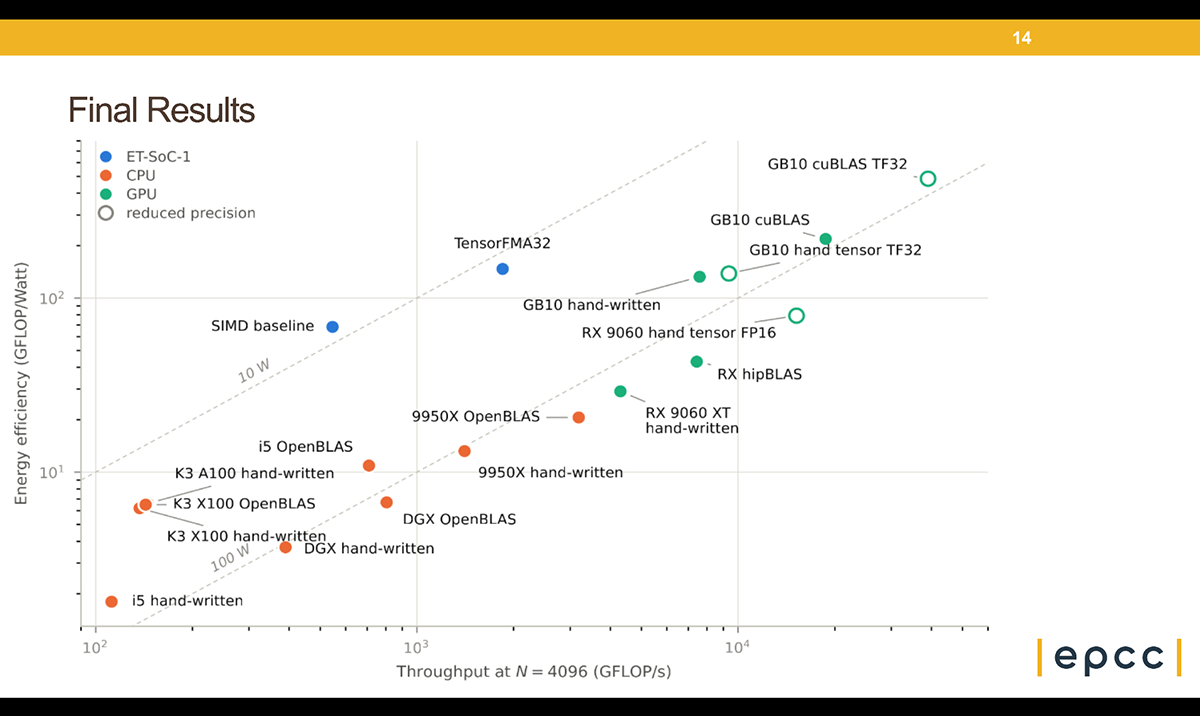
The resulting paper, Investigating ET-SoC-1 Vector and Parallel Performance with sGEMM, uses single-precision General Matrix Matrix Multiplication (sGEMM), a Level 3 BLAS operation, as a computational workload for evaluating performance.
The research I conducted examines several aspects of the ET-SoC-1, including computational performance, memory throughput, parallel execution and energy efficiency. It also compares the performance of the accelerator's vector and Tensor execution capabilities against mainstream CPUs from Intel, AMD and Arm, as well as GPUs from AMD and NVIDIA. The intention is not simply to establish how fast the hardware can perform matrix multiplication, but to understand how its different execution capabilities behave and where specialised RISC-V accelerator architectures might offer advantages for HPC workloads.
Having the opportunity to present this work at the SC26 RISC-V for HPC workshop provides an opportunity to contribute to a growing research community interested in the role of RISC-V in future high-performance computing systems.
Benefits of studying with EPCC
Being part of the wider EPCC family has been an important part of me reaching this point. What began as an online MSc during the COVID-19 pandemic has developed into doctoral research, access to specialist hardware, collaboration with experienced researchers and the opportunity to present my work at an international conference. It has also provided the opportunity to further investigate questions that I first encountered during my MSc and to develop them into a longer-term programme of research.
The ET-SoC-1 investigation is an early part of my programme. There is considerably more to explore in the use of vector and Tensor processing within RISC-V architectures, and I am looking forward to developing this research further during my PhD.
Author
Rich Neale
R.M.Neale-1@sms.ed.ac.uk
Links
For more details, see the paper Investigating ET-SoC-1 Vector and Parallel Performance with sGEMM
Richard’s SC26 RISC-V Workshop paper will be presented on Friday 20th November at 9:20am.
Follow Richard's work:
https://maths.earth/
https://github.com/mathsDOTearth
https://www.linkedin.com/in/rneale/
Read more about the work of Richard and other EPCC PhD students: Meet our PhD students