Wolfpine: a RISC-V simulator for the Tenstorrent Tensix architecture
17 November 2026
Can an outsider build a fully working simulator for Tenstorrent’s Tensix architecture using only publicly available information? The answer is yes! We have developed Wolfpine which is an extensible, Python-based simulator that runs TT-Metal binaries for Wormhole and Blackhole, and gives developers performance insight that goes beyond what is provided by Tenstorrent's own simulator or is visible on the hardware.
RISC-V based AI accelerators, such as those developed by Tenstorrent, have gained popularity for both AI and broader high performance computing (HPC) workloads. Traditionally, running code on Tenstorrent's Tensix architecture required physical hardware and in 2025 I thought that it would be useful to also be able to simulate code during development. But things never stay static and, after I released this, Tenstorrent made available their own simulator. However these two things are designed for different purposes.
Tenstorrent has committed to working in an open manner, for instance through its open source software stack, releasing technical architecture documentation ,and leveraging the RISC-V standard. Based on this, my hypothesis was that all this public information would be enough for someone external (ie me!) to develop an architecture simulator that would run binaries compiled by Tenstorrent's TT-Metal.
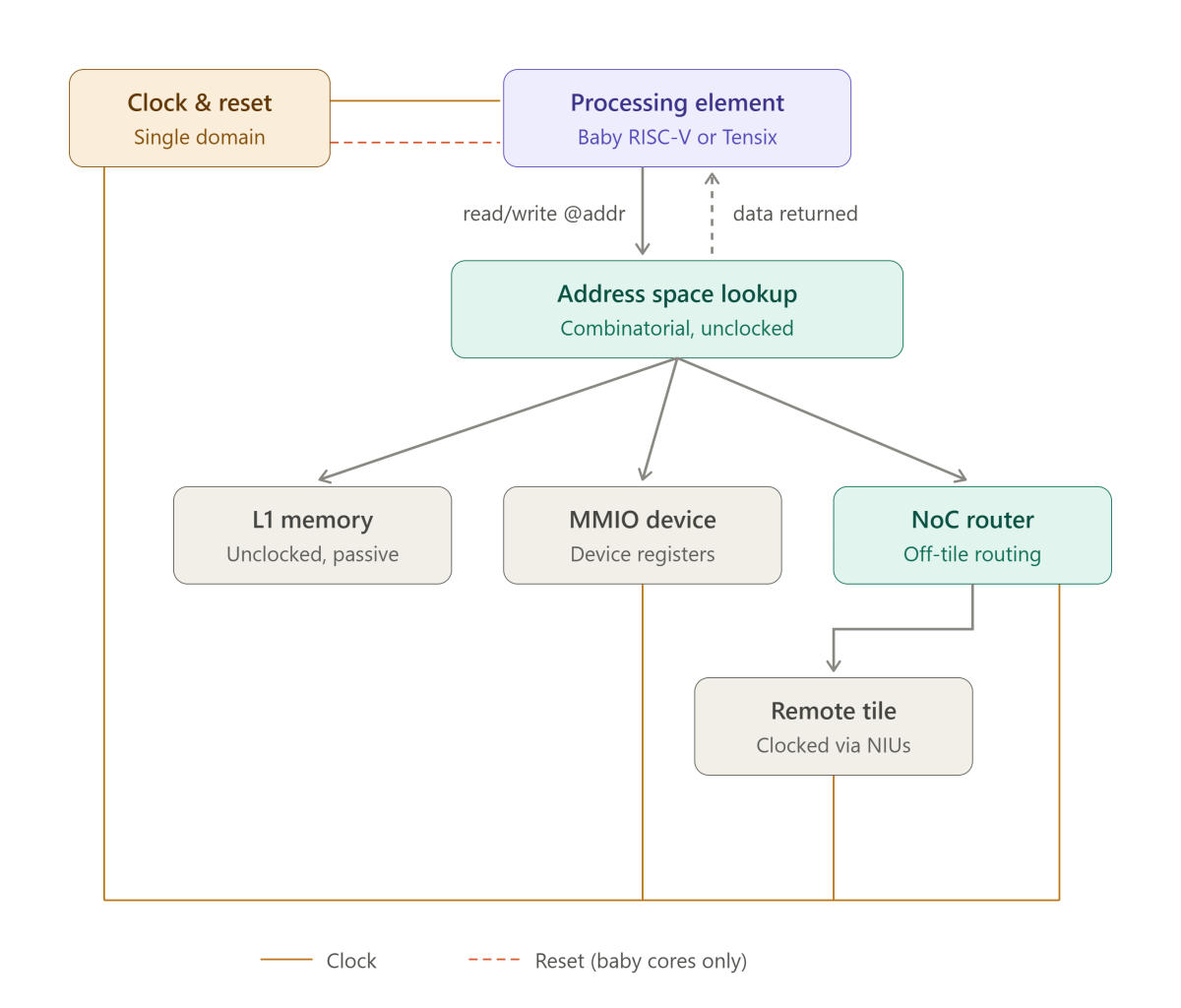
Above: Sketch of Wolfpine’s conceptual architectural approach.
The result of this is Wolfpine, which supports Tenstorrent's Wormhole and Blackhole generations. Written in Python for readability, it integrates seamlessly with the TT-Metal software stack just like Tenstorrent's simulator. Whilst the choice of Python might seem strange due to lower performance, I chose it to allow people to enter the simulator, more easily explore its different parts, and extend it.
The underlying model is similar to block design in Vivado, where a series of (software) IP blocks are instantiated, ports are connected and then memory mapping is specified to determine what data goes where on loads and stores. We JIT compile key parts, although this is still slower than Tenstorrent's own C++ simulator.
One of the purposes of Wolfpine has been to give programmers more insight about the performance of their code on the architecture. We therefore enhance performance diagnostics by offering typed event streams, component tracing, and timeline exports. All of these are designed to uncover bottlenecks in code execution that are not necessarily visible when running on the hardware.
Whilst Wolfpine is not cycle accurate, we include a provenance-tracked cost model to incrementally improve timing fidelity. This is very much aimed at providing increased fidelity when it comes to profiling, introspection, and debugging, extending quite a way beyond Tenstorrent's own simulator's capabilities.
Given RISC-V's open nature, Wolfpine is also designed to be adaptable, and indeed we have already provided blocks that implement the AME, IME and VME draft matrix extensions. We provide a simple RISC-V 64-bit CPU that integrates with these and enables the HPC community to experiment with those matrix extensions without requiring physical hardware, and broadening access to development and performance tuning.
Links
Wolfpine is open source and available on Github.
For more information, see the paper A RISC-V Simulator for the Tenstorrent Tensix Architecture.
EPCC at SC26
This work will be presented at SC26 on Friday 20 November. See the workshop A community developed simulator for the Tenstorrent Tensix architecture
For a full list of EPCC's activities at SC26, see our Events page.